This is part 4 (out of 4) of the EnergyNet white paper. Part 1 (with my little preamble) is here.
Across the European Union, cities such as Lund and Örebro in Sweden have begun deploying new DC microgrids, creating local demonstrations of EnergyNet's full potential. These pilots validate both technical feasibility and economic benefits, proving that EnergyNet can be scaled quickly, cost-effectively, and reliably.
Viable Cities, a strategic innovation program funded by Vinnova, the Swedish Energy Agency, and Formas, is pivotal in driving the climate-neutral transition across Sweden's cities. Uniting 48 municipalities, that together contain more than half the Swedish population, Viable Cities is spearheading local actions aimed at reaching climate neutrality by 2030 {16}.
Viable Cities emphasizes scalable and replicable solutions that can transcend Sweden's borders. By developing and refining effective energy-sharing practices, smart infrastructure, and sustainable mobility systems within Swedish municipalities, Viable Cities creates practical blueprints that other cities can adopt. This approach mirrors Sweden's pioneering telecom deregulation of the 1980s and 1990s, when strategic regulatory shifts and innovation policies demonstrated globally replicable models for market-driven infrastructure investment.
Just as Swedish telecom deregulation sparked competitive innovation and infrastructure transformation, Viable Cities leverages policy frameworks like the EU's energy community directives. Through active engagement in regulatory reform, Viable Cities ensures that cities can effectively implement innovative climate solutions such as EnergyNet-enabled communities and decentralized renewable energy systems.
Sweden's early leadership in telecom deregulation positioned it as a global telecommunications innovator. Similarly, Viable Cities positions Sweden as a leading nation in climate-neutral urban transitions. By scaling successful models globally, Viable Cities helps transform climate neutrality from local ambition to global de facto standards, demonstrating that effective regulation, market-driven innovation, and collaborative governance can drive sustainable infrastructure investments worldwide.
Sveriges Allmannytta is the national association representing municipally owned and longterm private housing companies in Sweden, collectively managing over 950,000 apartments across more than 300 housing providers. Together that is more than 20% of all Swedish households. It plays a vital role in advocating for sustainable housing, energy efficiency, and regulatory innovation on behalf of its members.
Under the banner of "Allman Energi", Sveriges Allmannytta has entered a strategic partnership with ViaEuropa, the world's first EnergyNet Operator, to accelerate the energy transition through municipally owned housing companies {17}. This collaboration aims to streamline the adoption of EnergyNet-based solutions, local energy production, storage, and sharing, across urban housing portfolios.
Housing associations engaged in this initiative include multiple members of Sveriges Allmannytta from places such as Örebro (ÖBO) and Lund (LKF), showcasing the applicability for both existing housing and new development through public-private partnerships implementing citywide deployment plans for each municipality.
The city of Örebro is part of the Viable Cities climate-neutral city alliance, and its municipal housing company, Örebro Bostader (ÖBO), is a system demonstrator partner for Sveriges Allmannytta's Allman Energi project, with an initial focus on installing EnergyNet in new developments, through collaboration with multiple partners including private developers and the local grid owner.
Tamarinden, located in Örebro, Sweden, represents an innovative "smart" neighborhood encompassing approximately 800 homes, a nursery, and commercial spaces. Initiated in 2020, Tamarinden stands out by aiming for near-total energy self-sufficiency by integrating solar photovoltaics, geothermal heating, battery storage, and shared electric vehicle infrastructure.
Crucially, Tamarinden pioneered the idea of cross-property electricity sharing. Initially restricted by Swedish law, local advocacy and regulatory reform led the Supreme Administrative Court to permit tax-exempt solar energy sharing from 2024 onward. This regulatory breakthrough has positioned Tamarinden as a replicable model for energy communities nationwide.
Early assessments from Tamarinden highlight significant efficiencies: a 30% reduction in energy consumption and a 50% decrease in peak power demand through predictive and optimized local energy management {18}.
Lund, a historic university city in southern Sweden, has a long-standing tradition of technology leadership and innovation. Home to Lund University, one of Scandinavia's oldest and most prestigious institutions, the city has been at the forefront of global technological advancements for decades.
The city of Lund is a member of the Viable Cities climate-neutral city alliance. Lund's municipal housing company, Lunds Kommuns Fastighets AB (LKF), is a system demonstrator partner for Sveriges Allmannytta's Allman Energi project, with an initial focus on installing EnergyNet in existing buildings.
In the 1980s and 1990s, Lund significantly influenced global telecommunications through Ericsson's local research center, and was instrumental in pioneering the GSM (Global System for Mobile Communications) standard. This groundbreaking work laid the foundation for today's global mobile wireless telecommunications connectivity.
In 1998, Lund further cemented its role as a technological innovator when Jonas Birgersson, then at Framfab (based in the IDEON Science Park), developed the world's first commercial broadband service. Officially launched in 1999 as Bredbandsbolaget, this pioneering company quickly became a leading challenger in broadband connectivity, fundamentally changing the landscape of high-speed Internet access and setting the standard for competitive, consumer-driven broadband services worldwide.
Today, Lund continues this tradition of pioneering technological leadership through ambitious initiatives such as the Brunnshog Innovation District, CoAction Lund, and the Lund Green Innovation District.
Brunnshog, located adjacent to world-leading research facilities MAX IV and the European Spallation Source (ESS), is a model of sustainable urban development. The district hosts Sweden's largest low-temperature district heating network, integrating innovative energy solutions, and serving as a real-world testbed for digital energy infrastructure, including EnergyNet-enabled, programmable microgrids, and peer-to-peer energy sharing.
CoAction Lund, a large-scale system demonstrator supported by Vinnova and led by the City of Lund, mobilizes over 25 partners across academia, industry, and government to achieve a climate-neutral city by 2030. CoAction Lund exemplifies how Lund leverages interdisciplinary collaboration, combining research excellence from Lund University, cutting-edge technologies from local companies, and innovative governance, to drive large-scale sustainability transitions. The Lund Green Innovation District is a "Sustainable Innovation Zone" in collaboration with the EnergyNet Task Force, Viable Cities, Global Urban Development (GUD), and other partners {19}.
Lund University, with its strong research in technology, sustainability, and digital infrastructure, has been a catalyst for continuous innovation.
5.4.4 Local Leadership
The City of Lund has among its elected officials not only leaders that have the will to continue to build on its history of innovation but also some key assets. With LKF, a for-profit housing and commercial development and management company completely owned by the city government, and the second largest local public utility company in Sweden, Kraftringen AB, that is majority owned by the city government, elected officials have substantial capability to modernize the city's infrastructure and facilitate major new green innovations such as EnergyNet.
On April 26, 2025, CoAction Lund officially launched the world's first operational EnergyNet system {20} marking a significant global milestone, similar to the first nodes getting connected to the Internet three decades ago. Developed collaboratively by LKF together with the Lunds Kommuns Parkerings AB (LKP) Lund Parking Company and ViaEuropa, this pilot employs an innovative "Freedom Cable" enabling a parallel DC microgrid to provide direct energy sharing between two buildings, each with rooftop solar, located inside both the Brunnshog Innovation District and the larger Lund Green Innovation District.
The traditional grid has brought electrification to billions and powered a century of growth, but it was never designed for decentralization, bidirectionality, or fully mobilizing the revolutionary capabilities of modern electronics and software. What the Internet did for communication, scaling up global access through open standards, hyperscale electronics, and new physical infrastructure, EnergyNet can now do for electricity.
What's needed is coordination, leadership, and the courage to transform the existing energy distribution system.
EnergyNet is a path forward that can lead to:
> Low fixed costs for clean local energy.
> Increased local and national energy independence.
> Enhanced resilience with no single point of failure.
> A potential breakthrough in electric vehicle and battery integration.
> An opportunity to free up grid capacity for electrification of data centers and advanced manufacturing facilities.
> Opening up a new era of digitally driven energy innovation.
This paper has outlined the architectural blueprint and operational model needed to move from pilot to scale. Just as countries that led broadband deployment now reap digital dividends, those who move first on EnergyNet can gain competitive energy, economic, and climate advantages that are both durable and transformative.
The grid of the past (and present) is centralized, locked, and fragile. The grid of the future will be distributed, open, and adaptive.
*EnergyNet as the key architecture for the 21st-century grid is an innovative solution that will unlock extraordinary opportunities for the world to "get richer by becoming greener".*
*The future of energy belongs not to those who wait, but to those who act.*
APPENDIX: What about Smart Grids?
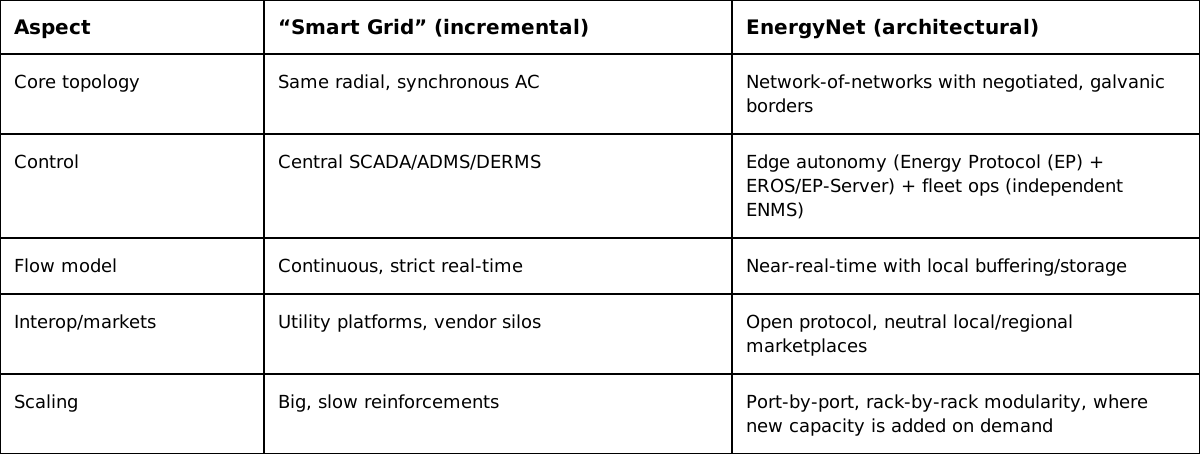
The smart grid era began with high hopes {21}: smart meters, sensors, and upgraded SCADA/ADMS would give operators real-time visibility, finer control, and fewer outages. Those programs delivered real value, better data, faster restoration, and volt/VAR optimization, but they largely left the core architecture unchanged: with radial feeders, one big synchronous machine, and a central control plane polling thousands of endpoints.
As distributed PV, batteries, heat pumps, and EVs surged at the edge, the returns to "more intelligence in the center" began to diminish; interconnection queues, feeder limits, and resilience gaps persisted. David Isenberg and the Net-Head´s telecom lesson applies: the Intelligent Network (smart in the core) could not match the Internet's "stupid network", a simple, abundant core with open Internet and edge intelligence.
Smart grid is the power sector analogue of the "Intelligent Network" in telecommunications: useful, but incremental {22}. Smart grid programs improved data and visibility, but left the radial, synchronous architecture unchanged. EnergyNet changes the architecture through digitally firewalled domains, near-real-time operation with local buffering, and policy-based interconnection.
EnergyNet is the architectural successor: a network of networks with digitally negotiated and galvanically separated borders, software-defined and edge-first control (EROS/EP-Server operated via independent ENMS), near-real-time operation with local buffering ("some power is better than no power"), open protocols such as Energy Protocol (EP) and neutral marketplaces, and port-by-port scaling on demand. If implemented at scale, EnergyNet has the potential to unlock unlimited green energy abundance.
Fig. 10. Smart Grid versus EnergyNet, compared in five key aspects.
All white-paper references are here.