This is part 3 (out of 4) of the EnergyNet white paper. Part 1 (with my little preamble) is here.
EnergyNet's robust and scalable architecture enables it to function in "near-real-time" instead of real-time. A core principle underlying EnergyNet's advanced architecture is the transition away from a strict real-time model, like the traditional power grid or the Plain Old Telephone System (POTS), towards a more robust and scalable near-real-time system inspired by the Internet's packet-switched network model.
Historically, the electrical grid required continuous, instantaneous balancing of supply and demand, with any mismatches immediately harming grid stability. Similarly, the legacy telephone system required dedicated circuits and real-time connections, leaving no room for delays or disruptions.
EnergyNet adopts a fundamentally different approach, using local energy storage and digitally managed buffering as analogs to the Internet's data caches and packet buffers. Instead of instantaneous power flows, energy is locally buffered, stored, and digitally routed based on software-defined priorities and negotiated exchanges. This "packetized energy" approach provides:
> Enhanced Robustness: Short-term storage and buffering make the system inherently tolerant to brief interruptions or imbalances.
> Simplified Management: Near-real-time management dramatically reduces complexity by eliminating the need for instantaneous global balancing.
> Scalability: Like packet switching in telecommunications, this architecture scales easily. New resources and storage can be seamlessly added, increasing capacity without complicating management.
By moving from strict real-time to near-real-time operation, EnergyNet achieves the same benefits that packet switching brought to telecommunications: a dramatically simpler, more resilient, and easily scalable system, perfectly suited for the diverse, distributed energy resources of the 21st-century.
In the traditional electrical grid, power delivery is fundamentally binary, either fully operational at 100% or experiencing a complete blackout at 0%. A significant drop in frequency or voltage typically triggers cascading failures, causing the grid to collapse entirely. This makes the traditional grid vulnerable and brittle, leaving critical infrastructure completely powerless during major disruptions.
EnergyNet fundamentally changes this dynamic by adopting a digitally coordinated, modular, and locally autonomous architecture. Instead of an "all-or-nothing" scenario, EnergyNet can maintain partial, but highly targeted, energy delivery under nearly any circumstance.
Key aspects of this resilience principle include:
> Priority-Based Energy Delivery:
EnergyNet continuously identifies and prioritizes essential equipment and critical services (such as routers, communications equipment, medical devices, or emergency lighting). In a disruption, the system automatically reallocates limited available power, ensuring the highest priority assets remain operational.
> Extended Partial Operation:
By intelligently managing local energy storage and generation resources, EnergyNet can sustain partial operations for extended periods, even if grid connections or higher-level communication networks (such as global cloud services) are disrupted. The local digital control within Energy Routers maintains robust command and coordination capabilities independently.
> Dynamic Adaptation and Local Autonomy:
EnergyNet's decentralized design allows each local node to independently reconfigure energy flows based on real-time conditions. Even if completely isolated from external networks or the traditional grid, EnergyNet dynamically reallocates and reshapes available resources to optimize survival and operational effectiveness.
This principle, ensuring "some power" rather than "no power", represents a transformative improvement in energy resilience. EnergyNet ensures critical digital infrastructure, communication capabilities, and essential local resources can remain functional far longer and more reliably than traditional grid infrastructure would allow, especially during crises or extended disruptions.
The Energy Protocol is an open standard communication framework at the heart of EnergyNet. It enables Energy Routers and networks to securely negotiate, coordinate, and exchange energy data, ensuring interoperability across different systems and vendors. Similar to Internet protocols like TCP/IP, the Energy Protocol enables reliable, transparent, and secure energy routing decisions {12}.
At the core of EnergyNet's digital distribution architecture is the Energy Router, a powerelectronics device designed to manage energy flows dynamically, software-defined, and safely. Like data routers in communication networks, the Energy Router directs electric power precisely where and when it's needed, enabling a flexible, responsive, and resilient energy system.
The Energy Router's ports can dynamically manage and vary the voltage level of the DC power being sent or received. Depending on system needs, local conditions, or connected equipment, these ports operate flexibly within defined voltage ranges, such as:
> 150 to 800 V DC (typical for many local storage solutions and EV charging).
> 150 to 1500 V DC (extended range suitable for larger systems, utility-scale storage, or advanced infrastructure requirements).
This variable voltage capability allows the router to precisely control power delivery, optimize efficiency, and ensure compatibility with a wide range of local generation, storage, and consumption devices.
In recent years, bidirectional power electronics — especially AC/DC and DC/DC converters used in electric vehicles {13}, battery storage systems, and local renewable energy integration — have experienced dramatic advances in both performance and affordability. Driven by the adoption of advanced semiconductor technologies {14}, particularly silicon carbide (SiC) and gallium nitride (GaN), converters now achieve significantly higher efficiency (often exceeding 98%), greater power density, and more compact sizes.
These advancements have already sharply reduced costs per kilowatt (kW), with the priceperformance ratio improving at rates comparable to the early stages of Moore's Law in computing. Industry experts anticipate that this trend will accelerate further, with continuous improvements expected over the next decade. Increasing production volumes, particularly driven by rapid electric vehicle adoption and widespread deployment of storage systems, will further drive down costs through economies of scale.
Looking ahead, future bidirectional converters are projected to become even smaller, more efficient, and cost-effective. Enhanced integration, simplified designs, and standardized modular architectures will lead to widespread adoption of high-performance, low-cost converters across all areas of energy management. These technological and economic trends will be a great driver for further accelerating the global transition towards dynamic, digitally coordinated energy networks, such as EnergyNet.
To ensure high availability and avoid any single point of failure, each Energy Router is typically equipped with two Energy Supervisors, redundant controller units that work together to provide uninterrupted coordination and operation.
Each Energy Supervisor runs the core digital systems that define the router's behavior:
> EROS (Energy Router Operating System): Responsible for managing internal port-toport energy routing logic, local prioritization, and switching decisions across the DC backplane.
> EP-Server (Energy Protocol Server): Manages secure negotiation and coordination with other Energy Routers and with the EnergyNet Operator using the open Energy Protocol and advanced Energy Network Management System (ENMS).
These dual supervisors operate in an active-passive or active-active failover mode, ensuring that if one module fails or requires maintenance, the other immediately takes over without disrupting energy flows or control logic. All configurations, energy routing tables, and protocol states are mirrored in real time.
This architectural redundancy mirrors the proven design practices found in telecom-grade and cloud infrastructure systems and is key to the EnergyNet mission of building selfhealing, highly resilient, and digitally autonomous microgrids.
By combining this dual-controller design with modular power ports and galvanic isolation, the Energy Router provides a dependable foundation for next-generation energy distribution, especially in mission-critical, community-scale deployments.
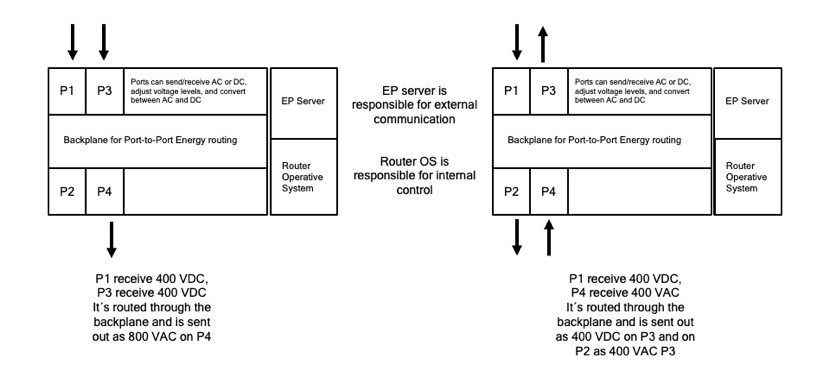
At the heart of the Energy Router is an internal DC backplane, functioning like a highcapacity internal "energy bus." This DC backplane connects all ports and provides a shared interface through which the Energy Router can, through software-defined commands, route energy from any input port (or ports) to any output port (or ports) depending on real-time demands and priorities.
Energy Routers follow a modular design philosophy inspired by the telecommunications industry, leveraging standard 19-inch telecom racks to simplify installation, scalability, and maintenance. Each Energy Router consists of individual converter modules, AC/DC or DC/DC, that can be added or replaced independently, allowing capacity to grow incrementally and cost-effectively as needed.
Thanks to significant improvements in power electronics (particularly compact, highly efficient GaN and SiC converters), modern converter modules are dramatically smaller and more powerful than previous generations. A single converter module often occupies as little as 1U (1.75 inches) of vertical rack space, sometimes supporting multiple ports in one module.
Given current industry developments, a standard 42U telecom rack can comfortably host a substantial number of Energy Router ports.
Typical module density:
> 1 or 2 ports per 1U module (common configuration); approximately 42 to 84 ports per full 42U rack.
> Advanced high-density modules (emerging): up to 4 ports per 1U module, potentially enabling more than 150 ports per rack.
In practical deployments, a reasonable, conservative estimate would be between 50-80 bidirectional ports per full 42U rack, ensuring ease of cable management, cooling, and maintenance.
This modular and scalable approach ensures Energy Routers can seamlessly adapt and expand to match evolving local energy requirements, maximizing flexibility, minimizing upfront investment, and future-proofing the energy infrastructure.
The modular, rack-based architecture of Energy Routers, combined with significantly lower costs per port, enables an entirely new level of system resilience. Because individual converter modules and their associated ports are inexpensive and easy to add, it's now practical to design networks without single points of failure.
With this approach:
> Distributed Redundancy: Multiple redundant ports and converters can be installed at low cost. If one module or port fails, energy flows automatically reroute through alternative functioning ports.
> Simplified Maintenance: Modular components can be individually replaced without shutting down the entire system, significantly reducing downtime.
> Enhanced Reliability: By eliminating reliance on a single critical component, the overall system becomes highly resilient, ensuring continuous operation and robust local energy autonomy, even in case of individual failures.
In short, modularity and cost efficiency don't just improve scalability and economics, they fundamentally enhance reliability, resilience, and system-wide robustness.
Fig. 6. Illustration of the main components of the Energy Router: ports, Operating System, and the EP-server. It also shows how electricity can be moved from any port to any combination of ports depending on the needs communicated over the Energy Protocol
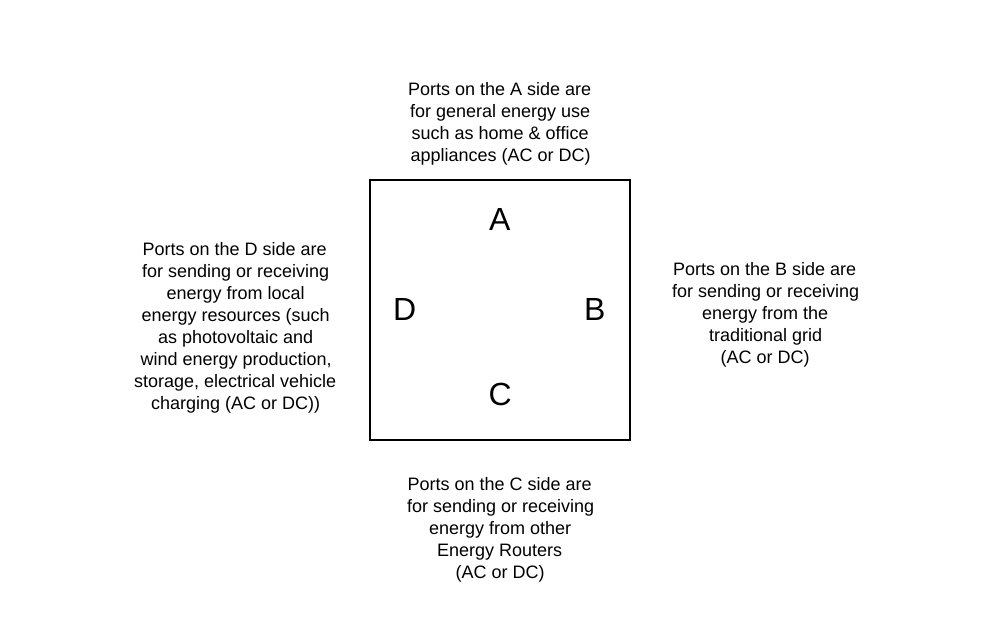
Fig. 7. Illustration of the four logic sides, same port but with different software logic applied based on what type of device is connected.
Acting as a digital gateway between ELAN/EWAN and the traditional grid, each router includes up to four different logic type of ports:
> Port A - AC port for local consumption (power to building or to tenants).
> Port B - AC port for traditional grid interconnection.
> Port C - DC port connecting to other Energy Routers for energy sharing.
> Port D - DC port connecting local energy resources (solar PV, batteries, EV chargers, etc.).
EnergyNet Operators perform roles analogous to Internet Service Providers (ISPs). They coordinate energy distribution, manage regional networks, and ensure reliable system-wide operations. Operators use the Energy Protocol to dynamically balance energy supply and demand, manage market-based exchanges, and facilitate coordination among local and regional networks.
EnergyNet Operators also maintain key relationships with local grid owners, municipalities, and end-users, ensuring that all parties benefit from a secure, efficient, and highly flexible energy distribution system.
As the number of deployed Energy Routers grows, from dozens in a pilot to thousands in a regional network, manual configuration and monitoring quickly becomes infeasible. This is where the EnergyNet Operator steps in, using a purpose-built Energy Network Management System (ENMS) to manage the distributed infrastructure at scale.
The ENMS is the digital control plane for EnergyNet operations. It provides the tools and automation required to provision, monitor, secure, and optimize a dynamic fleet of Energy Routers across neighborhoods, cities, or entire regions.
Provisioning & Lifecycle Management
> Remote onboarding of new routers with configuration profiles and Energy Protocol credentials.
> Policy-based role and behavior assignment for each Energy Router depending on its role (e.g., gateway, backbone node, or aggregation point).
Software and Firmware Management
> Secure distribution and orchestration of software updates for EROS and EP-Server.
> Staged rollouts with rollback capability to ensure system stability during upgrades.
> Real-time version tracking and compatibility management across hardware generations.
Advanced Cybersecurity Integration
> Continuous monitoring for anomalies, intrusion attempts, and firmware integrity.
> Role-based access control, encrypted communications, and secure boot validation.
> Integration with national and regional cybersecurity standards and response frameworks.
Predictive Maintenance and Health Monitoring
> Real-time diagnostics on temperature, voltage levels, switching performance, and hardware conditions.
> AI-powered analytics to detect early signs of failure or degradation.
> Predictive scheduling of component replacement or rebalancing of traffic loads.
Coordination and Optimization at Scale
> Real-time visibility into energy flows across the entire mesh of routers.
> Demand forecasting, local load balancing, and market integration.
> Policy enforcement for service level agreements, energy sharing rules, or emergency protocols.
By centralizing control and leveraging automation, the ENMS enables the EnergyNet Operator to offer carrier-grade reliability with the agility of distributed, software-defined infrastructure. ENMS enforces signed software images, mutual-Transport Layer Security (TLS) for EP control traffic, and role-based access (RBAC) with audit trails. Just as Internet Service Providers rely on NMS platforms to manage thousands of routers and switches, the ENMS is the critical software component for safe, scalable, and resilient EnergyNet deployments.
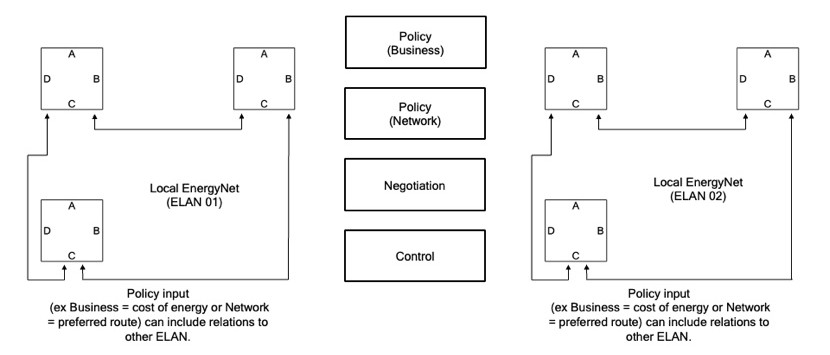
Fig. 8. Illustration of different system levels, priority inside the Energy Router, priority inside the ELAN, and priority between two interconnected ELANs.
To ensure scalable, secure, and efficient deployment and operation of decentralized energy networks, the EnergyNet Operator (ENO) adopts a structure similar to that of modern telecom or cloud service providers. Using the Enhanced Telecom Operations Map (eTOM) model from TM Forum as a reference, the ENO's functions span both Business Support Systems (BSS) and Operational Support Systems (OSS).
This model ensures that the operator can manage customer relationships, maintain network performance, and handle resource orchestration in a modular and standards-based way.
This also enables market competition and interoperability: multiple ENOs could operate over the same physical infrastructure, just like multiple ISPs or Mobile Virtual Network Operators (MVNOs) share telecom networks, encouraging innovation, customer choice, and regulatory oversight.
In addition to managing energy routing and operational services, the EnergyNet Operator (ENO) plays a key role as a neutral market facilitator, enabling dynamic and rule-based energy transactions across all layers of the EnergyNet architecture.
Within an Energy LAN (ELAN), such as a neighborhood, residential block, or industrial cluster, the ENO can operate a closed-loop marketplace where:
> Producers (e.g., rooftop solar, battery owners) offer energy capacity or flexibility.
> Consumers (e.g., homes, appliances, heat pumps, EVs) express real-time demand profiles or preferences.
> Routing priorities are negotiated dynamically via the Energy Protocol.
> Free energy sharing (peer-to-peer or community-based peering) can be supported to enable energy solidarity or nonprofit pooling models.
This local energy market functions with millisecond precision and high autonomy, even during upstream grid disconnection, ensuring resilience and resource optimization. Local peering (free sharing) can coexist with priced exchanges; EP messages capture policy/priority so that resilience goals are preserved even during market-based transactions.
Across an Energy WAN (EWAN), spanning towns, campuses, or districts, the ENO can:
> Aggregate surplus energy or flexibility from multiple ELANs.
> Operate routing nodes that match supply and demand in real time.
> Allow inter-ELAN energy trading, where energy can be monetized or bartered between cooperating microgrids.
> Set dynamic pricing signals or constraints to reflect network health, urgency, or policy objectives (e.g., carbon intensity).
Through standard APIs and secure interconnection layers, the ENO can integrate with:
> National flexibility markets, such as those operated by transmission system operators (TSOs).
> Wholesale and balancing markets for ancillary services or frequency control.
> Third-party energy service providers, energy communities, and retail suppliers offering innovative tariffs or grid services.
This ensures full vertical integration of the EnergyNet, from individual homes and buildings all the way up to national and transnational market structures, while preserving local autonomy, microgrid to microgrid interoperability, and traditional grid compatibility.
EnergyNet leverages diverse local energy resources, seamlessly integrating them to create a resilient and responsive energy network. This integration optimizes the use of renewable energy generation, storage, and flexible load management at the local and regional levels. EnergyNet Operators can facilitate and recommend, though it is always the owners of the energy resources that have final say on management decisions such as price and priority.
EnergyNet efficiently integrates local renewable generation, primarily from solar photovoltaic (PV) systems and local wind installations. These distributed resources provide clean renewable energy, significantly reducing dependency on centralized generation and enabling greater local autonomy.
A critical component of EnergyNet is energy storage, which balances supply and demand. Storage solutions include:
> Battery Storage Systems (stationary batteries, residential or commercial scale).
> Electric Vehicle (EV) batteries function as mobile storage assets (Vehicle-to-Grid).
> Alternative storage methods, including hydrogen-based storage systems.
Electric vehicle chargers in EnergyNet can do more than simply charge vehicles. Through smart bidirectional chargers, EVs become flexible balancing resources. They can store excess renewable energy and feed it back into local microgrids (Vehicle-to-Grid) when required, stabilizing and optimizing local energy flows.
EnergyNet can operate on existing local grid infrastructure, if the grid owner so decides. However, in areas where grid owners have not yet adopted EnergyNet, new infrastructure known as "Freedom Cables" can be deployed. These dedicated parallel cables ensure robust and flexible energy distribution, independently managed from legacy grid constraints. Inside the European Union through the EU's Energy Communities policy, traditional grid owners will no longer be able to legally block construction of new parallel power cable infrastructure {15}. This will make it much easier to bring new innovative energy solutions to the marketplace. It also can accelerate the adaptation of new architectures such as EnergyNet by traditional grid operators.
"Freedom Cables" can become necessary when traditional grid owners do not promptly adopt the open EnergyNet standard. Deploying these parallel cables enables communities and municipalities to rapidly achieve:
> Energy autonomy and enhanced local resilience.
> Accelerated integration of renewable energy generation and storage solutions.
> Ability to dynamically route energy, bypassing legacy grid bottlenecks.
The white paper is continued here (part 4 of 4).
All white-paper references are here.