I've been doing the part-time one-man-band PV installation work for a few years now. For my experience / skill level... the solo jobs have been complicated. For example: wall-mounted PV arrays, two-story-12/12-roof arrays, an off-grid Victron + Discover system, dialing in an Outback system that had a fried ESS, adding a BMS to a custom battery bank (work in progress), co-installing with difficult-personality DIYers...). Meanwhile, I've been building out spreadsheets in an attempt to better manage this varied complication.
I've so far been failing to make adequate income. I've been lacking the self discipline to let "good enough" be "good enough" (a blessing and a curse I guess). I take way too long to get quotes out. There's probably also some subconscious self sabotage going on here 😑.
I'm getting better over time, but ugh I still suck at managing tools, materials, and installation process. I'm the Magoo that can't find the channel locks he put down 30 seconds ago (oh, they're on the top of the ladder).
Separately, I see the awesome potential with flexible-load shifting / control. Especially for sites that tend to be occupied during the weekday (e.g. with home-office workers and stay-at-home parents). Repeating myself: With spare (free) PV power, dynamically: Pre-heat or pre-cool well-insulated homes in the afternoon (with heat pumps, to the edge of the comfort window). Pre-heat heat-pump water tanks (to the top of the rated window). Charge the EV. Run clothes / dishes cleaning machines. Etc. For homes that are mostly empty during the day... there are still flexible-load opportunities thanks to automation.
For a rad woman whose PV system is past its 20-year net-metering term: I recently helped with a system expansion. Over time, she and her little community plan to move more of their loads into the daytime. She's happy to do this. ...This was promising for me.
Making hay when the sun shines... This can help us have deeper relationship with the natural world and its cycles. Being aware of the sun's position over the day and the year... the shade cast by our trees. Having the best-available weather forecast. And loosely knowing the power requirements of disparate electrical loads. I get it that some people don't want to be bothered. But some people are game. By golly, for some people it'd be fun. These are people I want to serve. I assume it will get intuitive after a few months of active attention.
Many take it as a given that a system — post net metering — needs to have batteries. And if a system has batteries, then it should run the site's electrical when the grid is down. Better technology and supporting NEC code + UL standards... are making this easier and cheaper (e.g. ConnectDER MSAs). But it's still complicated and expensive. I've gone back to these sites repeatedly to troubleshoot issues (granted, most of these issues were on me).
To paraphrase Barry Cinnamon:
Grid-following PV-only systems... you can set them and forget them. Battery-backup systems... you'll have those customers on speed dial.
PV-only systems that turn off when the grid goes down... very cheap, very simple. I anticipate mostly installing in Oakland's flat areas, where the grid is reliable enough. There are cheaper ways to get thru rare ~two-day outages without spoiled food (a topic for another blog post).
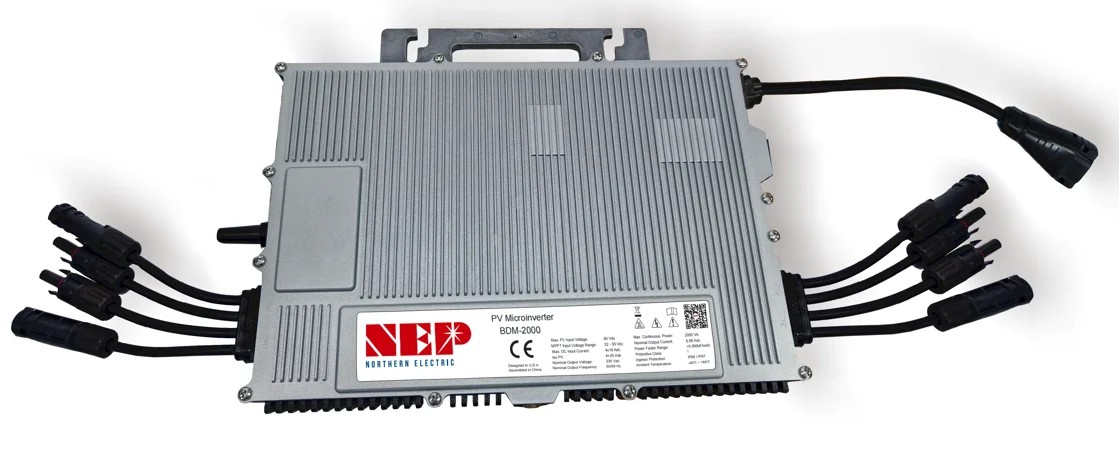
I had a blast at the recent NABCEP CE show. Going into it, I was yearning for a small barebones grid-following inverter (a friendly little box for the wall). It seems these are rare now, with all the hype around backup-capable inverters. I think I found what I was looking for in the exhibit hall. ...A four-module microinverter (micro) from Northern Electric Power (NEP). It supports modules up to 600 DC watts. It outputs up to 500 AC watts per module. For grid-exporting systems, NEP's gateway device is optional. ...The NEP micro can be wired directly into an electrical panel (no boxes on the wall).
This means one power-electronics device for the whole PV system. ...That is really cheap. I liked that NEP's Ben Montano straight-up said this is the main advantage with NEP micros. They're also built to last though (here's a fun related video with NEP's CEO). NEP started in 2009, and their HQ is in Pleasanton, CA.
I thought I had become a "pull DC down from the roof" kind of guy. But this micro got me thinking differently. One benefit with micros: I prefer to run wire thru the attic... it's cheaper and faster to run romex (an AC-only thing). Another benefit is checking the rapid-shutdown box as an afterthought (as much as I want to rock PV Hazard Control Systems).
Introducing: onGrid. A PV install company that only installs four-module (2-2.4kW) grid-dependent PV systems.
The parent company is Oakstead — the S Corp with the general contractor's license. Other more-complicated installs will be done thru Oakstead.
I have the `OnGrid` name now (for more on this, see here). I like the name. The company will support local open data access. In the spirit of this, the company name will rock camel case. The name will be `onGrid`.
The arrays must be contiguous rectangles (I can move obstructions if necessary, but this should be rare for these small arrays).
onGrid will probably be agnostic with modules and (flashed-mount) racking. Among the reputable options, go with what's cheapest.
The arrays will be installed in a way that supports later explansion. Examples: Install on the very corner of a roof face | plan for a second PV-wire circuit later. And the option of going off grid later will be in mind during system design.
Thru repetition of the same basic install... I'm stoked to eventually get the management of tools, materials, and process tight.
These systems will be cheap. Like... under-$2-a-watt cheap. For a small system with some occupant attentiveness or load control, in PG&E territory (with the most expensive electric rates in the continental U.S.)... this should typically be a banger $ investment (more on this later).
Again, onGrid will support a clean and simple user experience around monitoring real-time PV power and loads. ...At a glance, the occupant will know how much spare PV power is available. It'll also show — per billing period — the utility-bill reduction. For PV / load monitoring, onGrid will probably use Shelly monitors.
Thru onGrid — for the motivated DIYer — I also anticipate selling the four-module system's PV equipment as a kit (delivered by onGrid). ...With a video series + documentation + customer support that guides the DIYer thru the permitting / installation process and install process. onGrid will prepare the plan set. onGrid will inspect the system before the AHJ does. (Thanks to GoGreenSolar for PV-kit inspiration.)
There's a lot of hype now around plug-in solar (i.e. balcony solar). That's in large part on the PV industry for charging too damn much (and blaming it on "permitting and interconnection"). onGrid's option is a response to that. ...Still cheap, but with system inspections and formal utility interconnection.
I move slow and my business-acumen track record is dubious. I think onGrid — well implemented — would succeed. I'm still rooting for this guy (me). I'll report back.
COPY-PASTE FOOTER STUFF:
Join (or leave) my once-a-month email-newsletter list here.
This blog and AI: I use ChatGPT all the time, to understand things better. But these blog posts are 100% written by Mike (for better or worse).