The white paper's source is here.
The actual energy-net (open) protocol is here.
I (Mike) am not involved with this project (not yet at least). I'm re-posting here in part so I can read it on my phone in bed (with responsive text, on a webpage that matches system-level dark mode). I used ChatGPT in my PDF >> HTML conversion. Below doesn't exactly match the original (although I didn't knowingly revise any text).
I broke the white paper into four blog posts.
Blog post 1 (below)
1. Executive Summary: A New Grid Architecture for the 21st Century
2. Introduction and purpose
3. Why EnergyNet?
4. EnergyNet: the Internetification of Energy Distribution
5. Real-World Examples: Key Organizations and Projects
6. Conclusion: From Possibility to Deployment
APPENDIX: What about Smart Grids?
A How-To Guide for a 21st-century Energy System
Jonas Birgersson
Marc A. Weiss
Jimmy Chen
Daniel Kammen
Tomas Kaberger
Franklin Carrero-Martinez
Joakim Wernberg
Michael Menser
Newsha K. Ajami
Author organization affiliations and white-paper involvement are here.
In developing EnergyNet we have leveraged and are extending lessons from telecom's shift from a centralized, circuit-switched phone system to decentralized, packet-switched data networks. EnergyNet utilizes: 1) an Energy Router that enforces galvanic separation and utilizes software-controlled energy flows over a DC backplane, 2) Energy Local/Wide Area Networks (ELAN/EWAN) based on DC microgrids that interconnect through an open Energy Protocol (EP), and 3) a control plane comprised of the Energy Router Operating System (EROS) and EP Server which is managed at operator scale through an Energy Network Management System (ENMS).
We distinguish the architectural contribution (Tier-1: components, interfaces, operating model) from expected outcomes contingent on adoption (Tier-2). The latter includes local-first autonomy with global interoperability, near-real-time operation with local buffering, removal of EV-charging bottlenecks, freed grid capacity for data centers and industrial electrification, as well as a trend toward low, predictable, fixed-cost clean energy. Evidence from early municipal demonstrators illustrates feasibility and migration paths. The contribution is a coherent, open, and testable blueprint for software-defined, decentralized energy distribution, aligning power-systems engineering with networking principles and offering a practical route from legacy, synchronous grids to resilient, digitally routed energy distribution systems.
This paper introduces EnergyNet, an Internet-inspired architecture for electricity distribution, specifying its components, interfaces, and operating model.
EnergyNet is a modular, open architecture for energy distribution, with these key elements:
> the Energy Router (galvanic separation, DC backplane, variable-voltage ports).
> the control plane (the new open source Energy Protocol and Energy Router OS + EP-Server).
> ELAN/EWAN boundaries and the Energy Protocol for interdomain negotiation.
> the operator model (ENMS + BSS/OSS/eTOM alignment).
> deployment patterns (e.g., new DC microgrid infrastructure and co-deployment with fiber/LTDH), security, and governance assumptions.
The existing grid or Plain Old Grid System (POGS), while a technological marvel of its time, was built for the needs and technologies of the 20th century. Its centralized, rigid, and increasingly complex structure has now become a bottleneck, slowing progress at a moment when acceleration is urgently needed. Specifically, transmission to distribution linkages and the operational dynamics of distribution grids are not yet on a trajectory to become smart, adaptive systems capable of serving human, commercial, and industrial demands.
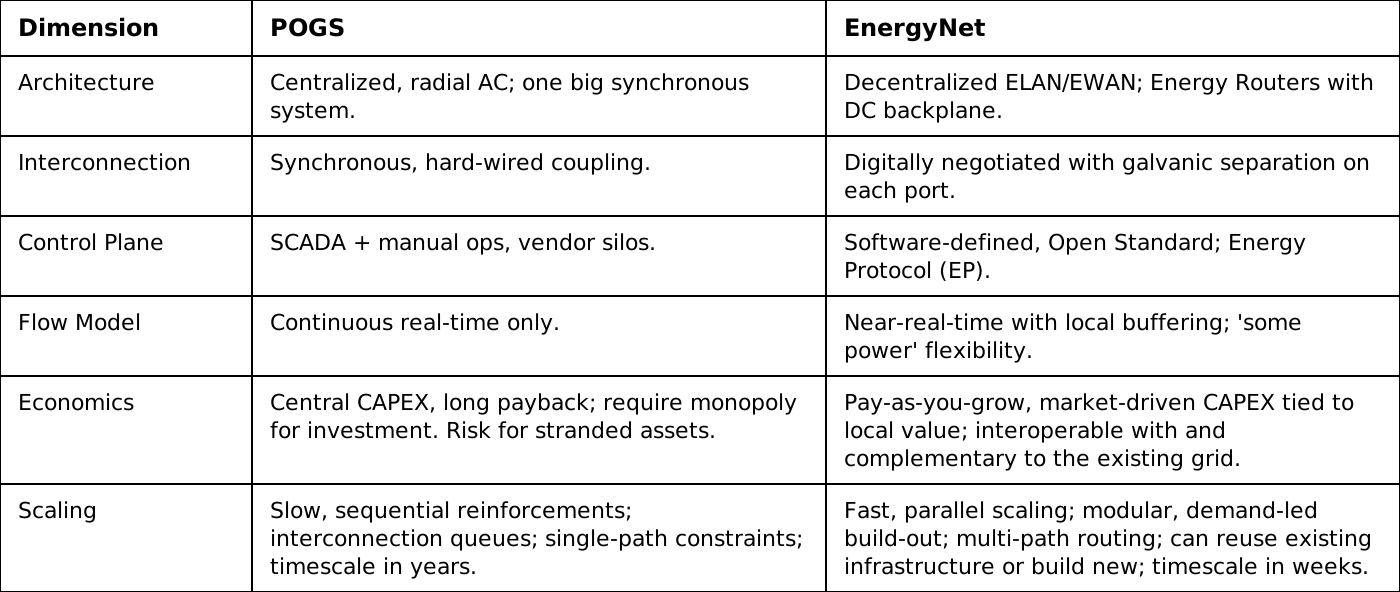
EnergyNet is a transformative system architecture, not a single technology, product, or vendor. By combining modular power electronics, software-defined networks, and new open protocols, it turns the distribution layer of the grid into a flexible, decentralized network of networks that can adapt to local needs and national demands. Here are some key differences between POGS and EnergyNet:
> From centralized to distributed energy systems, built for scalability and replicability.
> From analog control to digital coordination with software-defined routing.
> From closed proprietary systems to open source, enabling democratization of energy.
Drawing on Europe's deregulation successes and energy community reforms, we argue that, like mobile and broadband before, the next infrastructure wave primarily can be funded by market actors, and does not rely on government subsidies or monopoly charges.
This paper introduces the EnergyNet model, an Internet-style architecture for energy distribution, and provides a practical how-to for homes, buildings, communities, and urban/regional deployment. We define components and interfaces (Energy Router, ELAN/EWAN, Energy Protocol, EROS/EP-Server, ENMS), reference early demonstrators, and outline a scale-up roadmap. The aim is to enable replication and extension, inviting further research, pilots, and open implementation.
Our paper is written for those who want to move from concept to implementation, and lead the way in building a new grid for the 21st century.
The authors acknowledge valuable input from colleagues, industry experts, and support from OpenAI's ChatGPT in manuscript drafting, editing, and refinement. The authors bear full responsibility for all content presented.
Across the globe, the energy transition is facing a paradox. On one hand, renewable energy technologies like solar panels, batteries, and electric vehicles are becoming more affordable and available than ever before. On the other hand, our legacy energy distribution infrastructure - the traditional Alternating Current (AC) grid, or Plain Old Grid System (POGS) - is increasingly becoming a bottleneck. The result is that in many areas, renewable projects are being delayed or even canceled due to a lack of available grid capacity.
This is not a technology problem; it is an architecture problem. POGS was designed for one-way flows of power from centralized plants to passive consumers. It was never built to support dynamic, bidirectional flows between thousands of producers and consumers at the edge of the network.
The EnergyNet model, grounded in open standards and software-defined networks, offers a blueprint that any real estate owner or developer, city, region, or country can adopt and adapt, regardless of their starting point. It allows for rapid, market-driven deployment at scale, similar to how mobile networks and broadband scaled globally. Inspired by how the Internet transformed telecommunications, the EnergyNet model enables energy flows to become both adaptable and scalable, using software-based coordination across a "network of networks", corresponding to the decentralized infrastructure of the Internet.
This work began with growing frustration at today's traditional power grid. Once a marvel of human ingenuity that powered the early phase of electrification, it transformed societies across the 20th century. But what was revolutionary is now showing its age. The centralized, rigid, and complex distribution architecture has become a limiting factor. As new technologies proliferate and demand patterns shift, complexity and costs escalate while relief remains out of reach. The legacy grid has taken us far; its foundational structure now stands in the way of the flexibility, resilience, and innovation the future requires.
A similar moment arrived for fixed telephony (POTS — Plain Old Telephone System) in the late 1990s, when traffic shifted from short human calls to long modem sessions. The system strained and a fundamental architectural debate ensued. Two camps emerged: "Bell-heads," who pushed for bigger, smarter central switches, and "Net-heads," who argued for a simpler, decentralized architecture that pushed control to the edge. David Isenberg crystallized the Net-head viewpoint that the new "stupid network is a very smart idea" in an impactful article in 1997 characterizing it as a deliberately underspecified, abundant, packetbased fabric ("bits in, bits out") that unleashes innovation at the edge {1}.
In 1998, in Lund, Sweden, a small team led by fellow Net-head Jonas "Birger" Birgersson built a proof-of-concept along these lines. By 1999 {2}, {3}, {4}, {5}, {6}, Bredbandsbolaget deployed Ethernet-to-the-Home at national scale using commodity data-network gear to deliver 10/10 Mbps Internet for a low fixed price of 200 SEK (~USD 20) per month. When the incumbent Telia matched the offer later that year, the architectural debate was effectively settled; the principles behind the digitally innovative "stupid network" eventually became the global broadband standard.
The authors believe that we now face an analogous inflection point in energy. Just as the shift from circuit-switched POTS to packet-switched Internet required rethinking the fabric of telecommunications, POGS requires structural change: a distribution architecture that is modular, software-defined, and adaptable by design, with local autonomy and policy-based interconnection between domains.
The next sections introduce the EnergyNet model and its coordination logic, showing how this system-level shift can be implemented now with existing technologies, provided we apply a coherent EnergyNet architecture approach.
For a century, electricity was generated at a small number of large power plants and pushed outward over one-way, centrally coordinated networks. That architecture — radial feeders, synchronous coupling, and centralized protection — was optimized for predictable, top-down power flows.
The transition underway is the opposite. Generation is decentralizing; rooftop PV, batteries (including EVs), heat pumps, and flexible loads live at the edge. Power flows become bidirectional and intermittent, and coordination must happen locally and quickly. The legacy grid was not built for this: capacity fills, protection coordination breaks down, frequency/voltage control gets challenged, and single points of failure at substations and feeders reveal structural fragility.
Starting from a clean slate, a modern system would be local-first and digitally coordinated: microgrids with power-electronics frontiers (galvanic separation), software-defined energy flows, open protocols, local buffering/storage (near-real-time instead of strict real-time), and policy-based interconnection between domains. In short, a network of networks, simple and robust at its core, through dynamic capacity, resilience, and scale, by adding ports and nodes as needed.
EnergyNet is a blueprint. It replaces a centralized, hierarchically managed system with a modular, software-defined, interoperable architecture that lets communities produce, store, share, and trade energy locally, while interconnecting safely with the wider grid. By pushing intelligence to the edge and making interconnection simple, negotiated, and dynamic, EnergyNet turns the present bottleneck into a platform for growth: from scarcity to abundance, with lower and more predictable costs, greater resilience, and a faster path to electrification at scale.
In this paper, by applying principles of decentralization, openness, and local empowerment, we explore why the new grid that EnergyNet enables is so critically important for society. We will demonstrate how this new architecture could lead to an abundance of affordable clean energy, more resilient distribution, and improved energy independence.
EnergyNet reimagines energy infrastructure by applying the principles of the Internet to energy distribution:
> Local Generation: Solar panels and small-scale renewables generate energy where it is consumed, reducing the need for long-distance transmission.
> Local Storage: Home batteries and EVs store excess generation for local use when local production is not available or demand spikes.
> Local Sharing: DC microgrids and simple energy routing dynamically balance loads, generation, and storage, reducing peak demand stress on the broader grid.
This local, decentralized approach lowers operational costs (OPEX) and capital expenditure (CAPEX) per delivered kWh, enabling communities to move towards predictable, low fixed costs for the green energy they generate, store, and share locally.
Fig. 1. POGS versus EnergyNet, architectural, operational, and economic contrasts.
The housing sector is one of the largest, most overlooked levers in the energy transition. In the United States {7}, residential buildings account for approximately 38% of total electricity consumption annually, representing over 1.5 trillion kilowatt-hours in 2022 alone. In the European Union, same year {8}, households consumed an estimated 29% of final electricity consumption, with variations depending on climate, heating sources, and building efficiency.
While homes are often seen as passive consumers, this immense base of distributed demand can be transformed by EnergyNet into an active, flexible grid resource. Rooftop solar, home batteries, and EVs with bidirectional charging turn all homes into dynamic nodes for renewable energy generation, storage, and sharing in a fully decentralized system that still is interoperable with the traditional grid. By connecting them through open standards like the Energy Protocol, the EnergyNet architecture unlocks this latent capacity, not just for individuals to benefit, but as a cornerstone of national energy independence and resilience.
Every building, district, and municipality has a huge untapped potential: rooftops, space for batteries, and the ability to build new smart microgrids. When orchestrated through open standards and software-defined networks with dynamic sharing, these form the foundation of a new energy sovereignty. From the local perspective it is more important to determine how much energy will be needed by the community, rather than just calculating the amount of kWh that can be generated and stored.
The white paper is continued here (part 2 of 4).
All white-paper references are here.